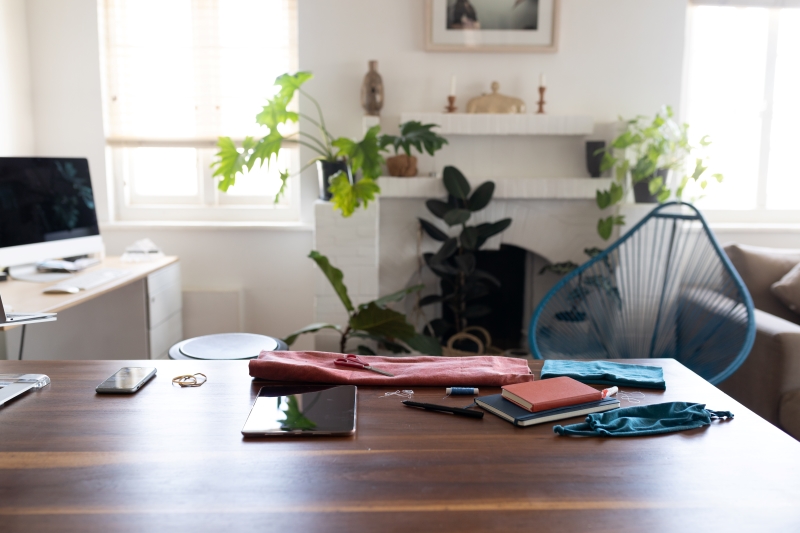
Your Space Is Talking to Your Nervous System. It’s Time to Listen.
Most of us think of our workspace as a backdrop.
A place where work happens. Neutral. Functional. Maybe a little messy, but that’s fine — we know where everything is.
What I’ve come to understand, both through my own work and in supporting clients through deep transformation, is that your environment is anything but neutral. It is in constant conversation with your nervous system. And most of that conversation is happening below the level of your awareness.
Every pile on your desk. Every drawer you’ve been meaning to deal with. Every object from a chapter of your life that’s quietly, technically, over.
Your brain is tracking all of it.
When a space feels cluttered or chaotic, the nervous system doesn’t think this person is creative and busy. It reads it as unfinished business. It keeps a low-grade alert running in the background — nothing dramatic, just a persistent, quiet hum of not quite safe. Not quite settled. Shoulders a little tight. Focus a little scattered. Breath a little shallower than it could be.
Now flip it. Walk into a space that feels intentional, clear, and supportive. The body gets an entirely different signal: you’re safe to think here. Safe to create. Safe to expand.
That’s not decoration. That’s biology.
A Few Simple Principles That Actually Work
I’m not going to give you a complicated overhaul. I’m borrowing a few ideas from feng shui — not as rigid rules, but as nervous system tools.
Start with what’s called command position — the practice of sitting where you can see the door rather than having your back to it. This sounds simple, but the physiological effect is real. When we can see what’s coming, the body relaxes. When we can’t, it stays subtly guarded. If you can’t move your desk, even a slight shift in your chair angle or a small mirror can change how your system registers the space.
Next: visual noise. Piles aren’t just piles — they’re cognitive load. Every stack your eyes land on is a quiet reminder of something incomplete. You don’t need to become a minimalist. Clear one surface. One drawer. One corner. That’s it. Small shifts create disproportionately large regulation.
Then open a window for nine minutes. I know it sounds almost too simple to mention, but fresh air is one of the most underrated tools we have. Let the body feel the signal: something is moving. Something is changing.
Finally, add meaning deliberately. Three to five intentional objects — a candle, a stone, a plant, something that carries significance for you. Not more clutter. Anchors. Reminders that say: I am safe. I am here. I am building something that matters.
The Question Underneath the Clutter
Here’s where it gets interesting.
Sometimes the physical mess isn’t only physical. Sometimes there’s an old notebook from an offer you’ve moved on from. A pile of papers from a season you’ve outgrown. An object connected to a version of you that over-gave, over-proved, over-worked — and doesn’t represent where you’re headed.
Your space is a mirror. And it’s worth asking, honestly: what in this environment belongs to an old chapter I’m ready to release?
You don’t have to answer that in a single afternoon. But you do get to start.
Choose one shift this week. Just one. Move your chair. Open the window. Clear one surface. Place something meaningful where your eyes naturally land.
Then check in: does your breath change? Do your shoulders drop? Does your mind feel even slightly more spacious?
That’s the whole point. Not a perfect room.
A regulated body. And the kind of clarity that only comes when you stop asking yourself to create in an environment that’s quietly asking you to grip harder.
The way your physical space affects your nervous system is just one layer of this work. If you’re curious about going deeper — into the patterns underneath the clutter, the ones that show up in your business and your relationships — The Transforming Force is where that conversation lives. Come take a look. [Join us here →]